
When Two Chokepoints Close: Ethiopia’s Reckoning with a Red Sea in Turmoil
GEOPOLITICSAFRICA
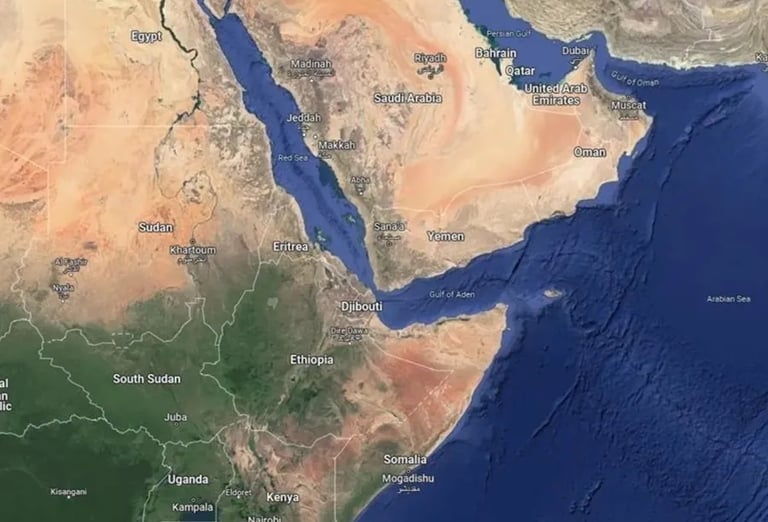
There is a particular kind of vulnerability that comes from having no coastline of one’s own. Ethiopia, Africa’s second-most populous nation and one of its fastest-growing economies, has lived with that vulnerability for three decades, routing the overwhelming share of its trade through a single foreign port. This week, the price of that arrangement became painfully visible yet again. Houthi missiles struck two Saudi-flagged tankers in the southern Red Sea. Roughly ten more vessels reportedly turned back rather than risk the same fate. This comes in the wake of Iran’s effective closure of the Strait of Hormuz further east. Two of the world’s most consequential maritime chokepoints are now under simultaneous strain, and the consequences will not stay confined to the Middle East.
Landlocked since Eritrea’s independence in 1993, Ethiopia sends more than 90 percent of its imports and exports through the Port of Djibouti, which sits directly at the mouth of the Red Sea’s southern gateway, the Bab el-Mandeb Strait. This is not a marginal trade relationship; it is close to Ethiopia’s entire external economic lifeline, covering fuel, fertilizer, food aid, manufacturing inputs, and the coffee, flowers, and textiles the country depends on for foreign exchange. Ethiopia already pays well over a billion dollars a year in port fees for this access, a cost so significant that Prime Minister Abiy Ahmed has compared it to the price of building a new Grand Ethiopian Renaissance Dam every three years.
The country has been here before, in a smaller way. During the previous round of Red Sea shipping disruption, Ethiopian importers saw the cost of shipping a single container from Shanghai to Djibouti roughly triple, while shipments that once took a month began taking a month to two longer, as vessels rerouted and transshipped through secondary ports. Delays at Djibouti’s terminals stretched well beyond their normal length. If Bab el-Mandeb now faces a sustained, deliberate blockade rather than episodic drone and missile attacks, those numbers could look mild by comparison. Fuel and fertilizer are the two commodities that matter most here. Ethiopia imports essentially all its petroleum products, and a large share of the fertilizer that underpins its agriculture-dependent economy arrives by sea. Persistent delays or price spikes in either would ripple straight into food prices and farm output for a population still suffering from food insecurity and conflict in several regions.
None of this is unique to Ethiopia, of course. Bab el-Mandeb and Hormuz together sit astride routes carrying a substantial share of the world’s containerized trade and a very large share of its oil and gas. Insurers are already repricing risk on vessels transiting either strait; shippers are already weighing the long, costly detour around the Cape of Good Hope; and energy and fertilizer markets are already jumpy. What makes Ethiopia’s position distinctive is that it has no alternative route to fall back on in the way that, say, a European importer might reroute a container ship. Ethiopia’s exposure is total, not partial, and its buffers — foreign exchange reserves, strategic fuel stocks, fiscal space to absorb price shocks — are thinner than those of wealthier trading nations.
Some of the response has to be domestic. Building and maintaining strategic reserves of fuel and fertilizer, even modest ones, would blunt the worst of any short-term supply interruption. Accelerating diversification of import routes — through Berbera in Somaliland, through Port Sudan where security allows, and through the long-discussed but still underdeveloped Lamu corridor via Kenya — would reduce the single-point-of-failure risk that Djibouti currently represents. None of these alternatives can fully replace Djibouti quickly, but even shifting a modest share of cargo volume would matter in a genuine crisis. Domestically, protecting fertilizer supply for the upcoming planting season should be treated as a food-security priority, not just a logistics problem, given how directly it feeds into rural livelihoods and inflation.
Much of this, though, is simply beyond what any single country can manage alone. Ethiopia has an interest in supporting, wherever it can, international naval efforts to keep Bab el-Mandeb open to commercial traffic, and in working through regional bodies — the African Union, IGAD, and its close coordination with Djibouti and Somalia — to present a unified voice on the economic stakes of the crisis to outside powers. International financial institutions and donor governments have a role too: emergency financing facilities, fuel and fertilizer subsidies, and trade credit guarantees are the kinds of tools that helped cushion African economies during the last global shipping crisis, and something similar will likely be needed again if this standoff drags on. Given how central Djibouti’s port fees already are to Ethiopia’s trade costs, there is also a case for the World Bank and African Development Bank to fast-track financing for the corridor diversification projects that have been discussed, but chronically underfunded, for years.
The uncomfortable truth is that Ethiopia’s vulnerability here was not created by this week’s missile strikes; it was created by thirty-plus years of accumulated dependency on a single, narrow gateway to the sea. The current crisis is simply the moment when that dependency is being tested in the open. How well Ethiopia manages the next few months will depend less on anything happening in the Red Sea itself, and more on whether the country and its partners finally treat maritime diversification as the strategic necessity it has long been, rather than a problem to revisit once the current storm passes.